
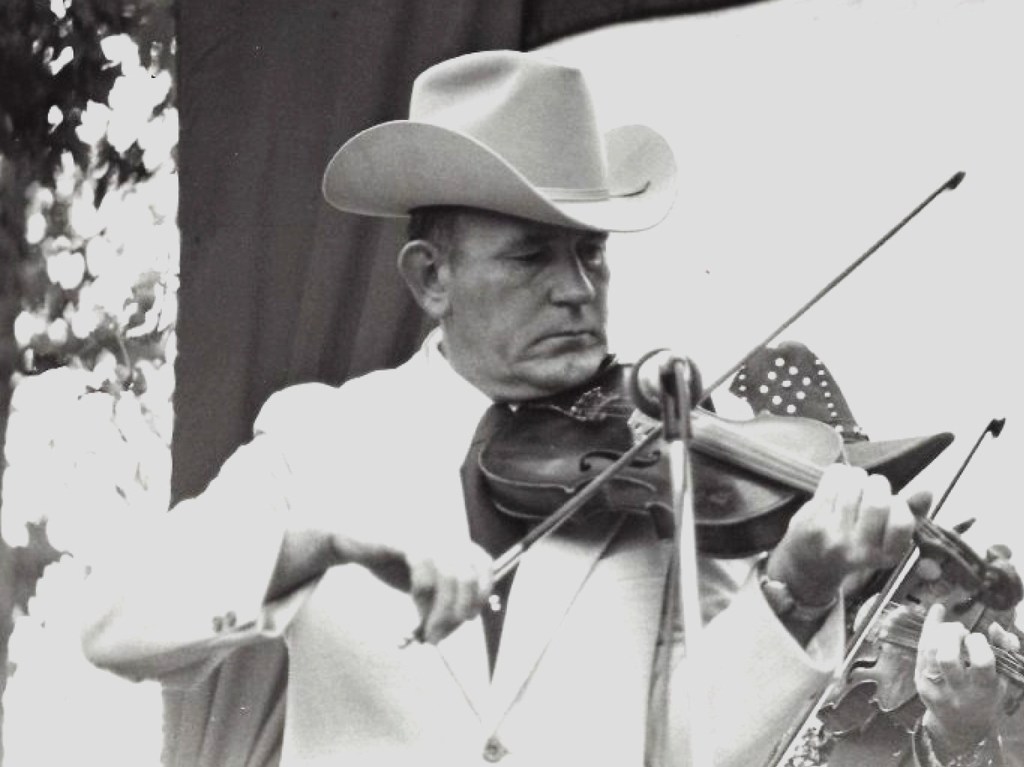
In the world of bluegrass music, few instrumentalists shaped the sound of a genre as decisively as Kenny Baker. With a bow arm as smooth as river water and a tone that seemed to glow from within, Baker elevated the fiddle from a fiery dance instrument to a vehicle for nuance, elegance, and emotional depth. For many musicians, Kenny Baker is not just a bluegrass fiddler—he is the bluegrass fiddler, a standard against which all others are measured. His long partnership with Bill Monroe and his extraordinary body of solo work helped define what the fiddle could be in bluegrass, giving the music a lyrical voice that continues to resonate today.
Early Life and Musical Roots
Born in 1926 in Burdine, Kentucky, Kenny Baker grew up in the heart of Appalachian coal country, surrounded by the traditional fiddle tunes, ballads, and dance music that shaped the musical culture of eastern Kentucky. His father, also a fiddler, was his earliest influence. Young Kenny listened intently as his father played older regional tunes—many in modal scales and cross-tunings that carried remnants of Scottish and Irish fiddle traditions. The Bakers were a musical family, and gatherings often featured not just fiddles, but banjos, guitars, and the drive of the region’s dance rhythms.
Kenny served in the U.S. Navy during World War II, and upon returning home, he began playing at local dances, radio shows, and community events. His early style already hinted at what would later make him famous: long, fluid bow strokes; careful attention to intonation; and a deep respect for the melody. His playing stood out in an era when many fiddlers favored flash over finesse. Baker played with intention, patience, and remarkable control.
Career Highlights and Collaborations
Kenny Baker joined Bill Monroe and the Blue Grass Boys in the mid-1950s, marking the beginning of a partnership that profoundly shaped the direction of bluegrass fiddling. Although he came and went from Monroe’s band over several years—returning for extended periods in the 1960s and 70s—Baker became Monroe’s most enduring and influential fiddler.
Under Monroe, Baker was given both freedom and responsibility. Monroe adored fiddle music, especially old-time tunes, and he encouraged Baker to retain the roots of Appalachian fiddling while refining it into something uniquely suited to bluegrass. Their collaboration resulted in some of the finest fiddle recordings in the genre’s history.
Baker contributed to many of Monroe’s major albums and helped shape iconic instrumentals such as:
- “Jerusalem Ridge”
- “Wheel Hoss”
- “Lonesome Moonlight Waltz”
- “Road to Columbus”
These tunes became part of the bluegrass canon, with Baker’s bow work setting the interpretive standard for generations.
Beyond Monroe, Kenny Baker recorded numerous solo albums—several with legendary guitarist Josh Graves—and collaborated with artists across bluegrass, old-time, and early country music. His duet and trio recordings, in particular, highlight his ability to bring subtlety, swing, and grace to every musical setting.
Musical Style and Innovations
Kenny Baker’s style defies easy description because it was both deeply traditional and quietly revolutionary. While many bluegrass fiddlers leaned into high-energy bowing and improvisation, Baker fused the precision of old-time fiddling with the smoothness of Western swing and the phrasing of a crooner.
Several characteristics defined his artistry:
Silky, Long-Bow Technique:
Baker could hold a bow stroke longer and smoother than almost any fiddler of his era. This allowed tunes to breathe, giving melodies a vocal, singing quality.
Melodic Fidelity:
He rarely strayed far from the core melody, preferring subtle variations that enhanced the tune rather than showcasing technical flash.
Elegant Phrasing:
Each tune unfolded like a story. Baker shaped his lines with rise and fall, tension and release—reflecting a musical maturity often associated with classical violinists.
Deep Groove and Timing:
Even in fast breakdowns, Baker’s sense of rhythm was impeccable. He gave bluegrass its “dance,” even when the music was not literally for dancing.
Expansion of the Bluegrass Fiddle Repertoire:
Perhaps Kenny’s greatest contribution was elevating lesser-known fiddle tunes to standard status. His recordings of tunes like “Grey Eagle,” “Big Sandy River,” and “Scotland” expanded the vocabulary of the bluegrass fiddle, offering players new avenues for expression.
In short, Kenny Baker didn’t just play the fiddle—he sculpted melodies with it.
Influence on Bluegrass and American Roots Music
Kenny Baker’s influence is woven deeply into the fabric of bluegrass. He set the stylistic template for what many players now consider “modern traditional” fiddle playing. His sense of taste, timing, and tone became the benchmark for aspirational fiddlers.
Among professional musicians, Baker’s recordings are often referred to as required listening. Countless fiddlers, including icons like Stuart Duncan, Michael Cleveland, Byron Berline, and Alison Krauss, have cited him as a primary influence.
Furthermore, Baker helped stabilize and define the fiddle’s role in bluegrass ensembles. Rather than competing with banjos and mandolins for attention, his playing complemented and enriched the ensemble sound. His approach revealed new possibilities for arranging, harmonizing, and refining the emotional character of fiddle tunes within a band context.
Through his work with Monroe, Baker also helped shape the bluegrass genre during a pivotal era when it was transitioning from regional tradition to national stage. He, perhaps more than any other fiddler, upheld the tradition while gently lifting it into a more polished, expressive realm.
Later Years and Legacy
Kenny Baker continued performing and recording well into his later years, often pairing with Josh Graves for projects that showcased both musicians’ deep love of fiddle and dobro traditions. Even as trends in bluegrass shifted toward speed and technical flash, Baker remained a steadfast advocate for melody, tone, and musical storytelling.
He retired from full-time performing in the early 2000s, leaving behind a rich catalog of recordings that are still studied closely by aspiring fiddlers. Baker passed away in 2011, but his legacy—like his music—has never faded.
Today, he is remembered as one of the greatest fiddlers in the history of bluegrass and one of the most respected instrumentalists in American roots music. His contributions cannot be overstated: he brought beauty where there was once only fire, refinement where there was once only exuberance, and emotional depth where there was once only speed.
Conclusion
Kenny Baker’s place in bluegrass history is secure and profound. As Bill Monroe’s longest-standing and most influential fiddler, he gave the music its lyrical soul. Through his silky bowing, melodic devotion, and timeless recordings, he shaped generations of musicians and listeners alike.
Bluegrass fiddle music will continue to evolve, but the foundation laid by Kenny Baker—smooth, expressive, rooted in tradition yet elevated by artistry—remains unshakable. His music is more than technique or repertoire; it is a reminder of how much emotion, beauty, and humanity can live inside a single, perfectly placed note.
 World Bluegrass Day®
Leave a comment