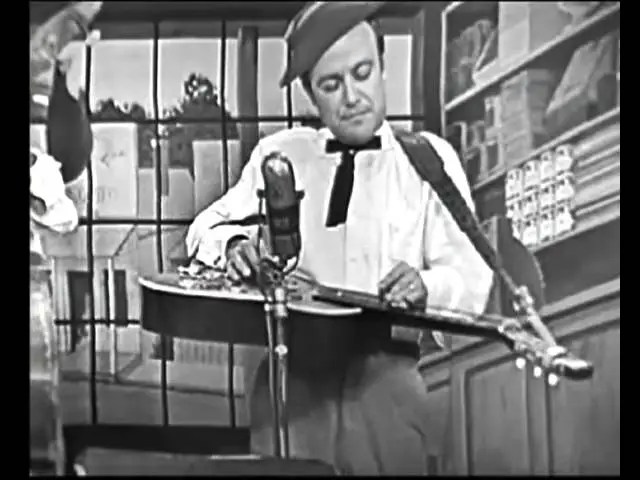
In the rich landscape of bluegrass history, every instrument has its guiding pioneer—those rare musicians who do not merely play, but transform. For the resonator guitar, no figure stands taller than Josh Graves, the man who introduced the dobro to bluegrass and elevated it from a supporting curiosity to a defining voice within the genre. With his dazzling right-hand technique, unmistakable slides, and rhythmic authority, Graves brought blues, country, and mountain influences together in a way that forever changed the sound of bluegrass music.
Graceful, inventive, and relentlessly musical, Josh Graves became as essential to the bluegrass ensemble as the banjo and mandolin. His work with Lester Flatt, Earl Scruggs, and the Foggy Mountain Boys stands among the most influential in the history of acoustic music, marking him as a true architect of the bluegrass sound.
Early Life and Musical Foundations
Burkett Howard “Josh” Graves was born in 1927 in Tellico Plains, Tennessee, a region where Appalachian traditions ran deep and music accompanied nearly every gathering. He grew up during the golden age of early country radio, absorbing influences from the Carter Family, Jimmie Rodgers, and especially blues players whose phrasing would later define his dobro sound.
Before ever touching a resonator guitar, Graves was already a skilled musician. He played upright bass, guitar, and—most fatefully—had a natural ear for the rhythms that drove early country and stringband music. His introduction to the dobro came through the trailblazing work of Cliff Carlisle, one of the first country musicians to popularize the lap steel style. Graves took to the instrument immediately, hearing in its voice a place where the blues could meet mountain melodies and old-time music could shimmer with emotional nuance.
By his teens, he had begun to merge these influences into a personal style—fluid, rhythmic, and expressive—and soon found himself performing on local radio programs across Tennessee and Kentucky.
Career Highlights and Collaborations
Josh Graves’ career changed forever in the mid-1950s when he joined Lester Flatt and Earl Scruggs and the Foggy Mountain Boys—one of the most important bluegrass bands of all time. Flatt and Scruggs were masters of ensemble innovation, and Graves brought to their group an entirely new layer of sound: a resonator guitar voice capable not only of supporting the band, but also of taking solos that matched the intensity and drive of Scruggs’ banjo.
Graves quickly became a featured soloist, appearing on countless recordings and classic cuts that helped define the dobro’s vocabulary. His breakout pieces included:
- “Shuckin’ the Corn”
- “Foggy Mountain Rock”
- “No Mother or Dad”
- “Fireball Mail”
His dobro solos became signature moments in the Foggy Mountain Boys’ shows and broadcasts, and audiences began to associate the instrument with the band’s sound. Graves had effectively introduced the dobro to mainstream bluegrass.
Throughout the 1960s and 70s, Graves toured and recorded extensively, not only with Flatt & Scruggs but also with artists like Kenny Baker, Chubby Wise, Mac Wiseman, and the Earl Scruggs Revue. His partnership with fiddler Kenny Baker was especially beloved, producing recordings that highlighted the interplay and nuance between slide guitar and long-bow fiddle. These collaborations stand today as essential listening for anyone exploring bluegrass instrumental music.
Musical Style and Innovations
Josh Graves did not merely add the dobro to bluegrass—he reinvented how it could be played. Before Graves, the resonator guitar was largely used as a gentle, rhythmic, or Hawaiian-style instrument. Graves transformed it into a lead instrument of power and drive.
His innovations included:
Borrowing and adapting Scruggs-style rolls:
Graves was the first dobro player to apply right-hand patterns similar to Earl Scruggs’ three-finger banjo technique, resulting in rapid, cascading notes that allowed the instrument to keep pace with bluegrass tempos.
Blues phrasing and vocal slides:
One of Graves’ greatest gifts was making the dobro “speak.” His slides were expressive and vocal, drawing from blues guitarists he loved as a boy. This blend of blues and Appalachian melody gave his playing emotional weight that resonated with listeners.
Rhythmic drive:
Graves provided a percussive, pulsing rhythm that filled the sonic space between the mandolin chop and the bass, helping bind the band together. This rhythmic phrasing became a defining characteristic of modern dobro playing.
Expansion of repertoire:
Through his arrangements and improvisations, Graves helped expand the melodic possibilities of the dobro, giving future musicians a template for both traditional playing and more exploratory approaches.
The result was a new language for the instrument—one now studied, imitated, and celebrated by players across bluegrass, Americana, and even contemporary acoustic genres.
Influence on Bluegrass and American Roots Music
Josh Graves is often referred to as “the father of the bluegrass dobro,” and for good reason. Before him, the instrument had no established role within the bluegrass ensemble. After him, it was impossible to imagine bluegrass without it.
His direct and indirect influence is massive. Every major dobro player who followed—including Mike Auldridge, Jerry Douglas, Phil Leadbetter, Rob Ickes, Josh Swift, and many others—cites Graves as the foundational master. His playing style became the bedrock upon which all modern dobro technique is built.
Graves also influenced band dynamics, showing how the dobro could weave through a bluegrass arrangement, offer counterpoint to the banjo, harmonize with the fiddle, and fill emotional spaces within vocal songs. His bluesy inflections broadened the expressive palette of bluegrass music, encouraging musicians to incorporate more diverse phrasing and tonal colors.
In essence, Graves didn’t just elevate his instrument—he enriched the entire genre.
Later Years and Legacy
Josh Graves continued performing well into his later years, joining reunion tours, recording solo albums, teaching workshops, and mentoring younger musicians. His stories, humor, and deep love for the music endeared him to fans and fellow artists alike.
Even as health challenges slowed his touring, Graves remained a powerful presence in the bluegrass world, often appearing at festivals and gatherings where his contributions were celebrated. He passed away in 2006, leaving behind a legacy that shaped not just an instrument, but the character of bluegrass music itself.
Today, recordings of Graves are foundational study material for aspiring dobro players. His work stands as a testament to creativity, courage, and the willingness to expand tradition without abandoning it.
Conclusion
Josh Graves was more than a dobro player—he was an innovator who gave bluegrass a new expressive voice. His extraordinary musicianship transformed the resonator guitar into one of the genre’s essential instruments, and his drive, phrasing, and melodic intuition continue to inspire musicians around the world.
Whether blazing through a fast instrumental or adding bluesy warmth to a ballad, Graves gave bluegrass its slide, its sway, and a bit of its soul. His legacy lives on in every dobro that takes a break onstage, in every young musician learning forward rolls and slides, and in the enduring sound of bluegrass itself.
 World Bluegrass Day®
Leave a comment