Plenty of bands define an era. Very few define a genre.
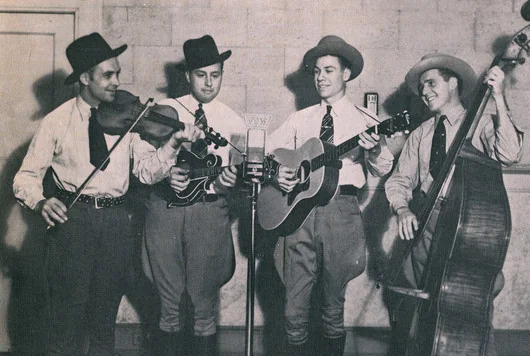
Bill Monroe’s Blue Grass Boys did both—almost by accident at first. The name “Blue Grass Boys” started as a nod to Monroe’s home state of Kentucky. But within a few short years, that band name became the word the world used for an entire sound: bluegrass.
What made it happen wasn’t just one song, one night, or one lineup. It was something rarer: a working band that kept evolving, recruiting, refining, and raising the bar until a new style became undeniable.
The name came before the genre
In 1938, after the breakup of the Monroe Brothers, Bill Monroe formed his own group—eventually known as the Blue Grass Boys. At that moment, nobody was calling the music “bluegrass.” It was still filed under country, hillbilly, string band, or mountain music depending on the venue and the audience.
But Monroe was already chasing a specific feel: tighter rhythm, cleaner attack, higher harmony, and more intensity than the typical string band of the day.
Radio turned a regional sound into a national proving ground
When Monroe and his band earned a regular spot on the Grand Ole Opry in October 1939, the stakes changed overnight. The Opry wasn’t just a show—it was a weekly national stage where a band’s timing, polish, and excitement were tested in real time.
Monroe’s music hit hard on the radio: fast tempos, crisp ensemble playing, and a vocal edge that sounded both old and electric. Even before bluegrass had its name, the Blue Grass Boys were already building its expectations.
The lineup that lit the fuse
Every era of the Blue Grass Boys mattered, but the stretch that most people point to as the “spark” is the mid-1940s—especially after Earl Scruggs joined in late 1945.
That classic lineup—Monroe on mandolin, Lester Flatt anchoring guitar and lead vocals, Scruggs bringing the revolutionary three-finger banjo drive, plus powerhouse fiddle and upright bass—did something more than play great music:
They introduced a new structure and energy that listeners could instantly recognize.
Instrumental breaks stopped being occasional ornaments and became the engine of the performance. The rhythm locked into a forward “push.” The vocals carried a sharper, higher tension—what fans later called the high lonesome sound.
And once that sound was captured on the band’s key mid-to-late-1940s recordings, bluegrass wasn’t just happening live on Saturday night—it became something musicians everywhere could learn, imitate, and build on.
What made the Blue Grass Boys different
A lot of great groups existed in the same era. The Blue Grass Boys became the template because they combined several things at once:
- Drive: a relentless forward rhythm that feels like it’s leaning into the next beat
- The mandolin chop: Monroe’s percussive rhythm that made the band sound like it had a snare drum without having one
- Break-based arrangement: each instrument stepping forward to speak, then falling back into the ensemble
- Precision: clean timing and sharp attack—no “mud” in the rhythm
- Vocal identity: tight harmonies, emotionally direct lyrics, and that high, cutting edge that still defines bluegrass singing
In short: the Blue Grass Boys didn’t just play songs—they played a system.
The “university” of bluegrass
One of the most remarkable facts about the Blue Grass Boys is how long the band ran—and how many future legends passed through it. Over roughly 58 years (1938–1996), the band included more than 150 different musicians.
That’s why people often call it the University of Bluegrass. Monroe recruited hungry talent, demanded excellence, and—intentionally or not—trained a generation of bandleaders.
Some stayed and became part of defining lineups. Others stayed just long enough to learn what that level felt like—and then left to build their own sound.
Alumni who carried the genre forward
If the Blue Grass Boys created the blueprint, the alumni built the neighborhood.
- Flatt & Scruggs left in 1948 and formed their own powerhouse act, bringing bluegrass to enormous new audiences.
- Don Reno stepped into the banjo spotlight with Monroe soon after, proving the band could regenerate its fire even after major departures.
- Jimmy Martin helped define a later era of the band’s vocal drive and stage force.
- Later “Blue Grass Boys” included major names like Mac Wiseman, Del McCoury, Bobby Hicks, Vassar Clements, and Peter Rowan—each of whom went on to shape bluegrass in a distinct way.
That alumni network is part of why bluegrass spread so quickly: the core values of the sound—drive, breaks, harmony, precision—kept reappearing in new bands, new regions, and new decades.
Why one band could create a genre
Bluegrass didn’t become bluegrass because someone wrote a manifesto. It became bluegrass because one band made a sound so clear—and repeated it so consistently at such a high level—that the world needed a word for it.
The Blue Grass Boys weren’t just an influential group. They were the workshop where the style was forged, tested, rebuilt, and passed on.
And that’s why, even today, you can still hear it in the most basic bluegrass moment of all: a band leaning into the beat, handing the break around, and singing a harmony that sounds like it came from the mountains and the microphone at the same time.
 World Bluegrass Day®
Leave a comment