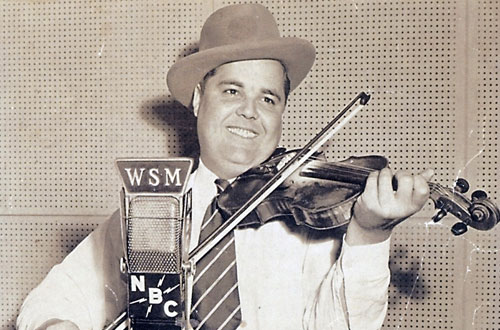
When people talk about the roots of bluegrass fiddle, one name comes up time and again: Chubby Wise. With his soaring bow work and distinctive tone, Wise helped define the role of the fiddle in bluegrass music. A member of Bill Monroe’s Blue Grass Boys during the genre’s formative years, and a lifelong ambassador of traditional Southern music, Wise left a legacy that still echoes through the halls of American fiddle playing.
From the Sunshine State to the Spotlight
Robert Russell “Chubby” Wise was born on October 2, 1915, in St. Augustine, Florida. Raised in a musical family, he picked up the fiddle as a teenager and began absorbing the sounds of the South—old-time tunes, Cajun music, swing, and early country.
By his early 20s, Chubby was performing professionally, quickly earning a reputation as a fiery and imaginative fiddler. His style combined technical precision with expressive flair—he could swing, mourn, or drive a breakdown with equal authority.
Bluegrass Pioneer with Bill Monroe
Wise’s most historically significant role came in 1942, when he joined Bill Monroe and the Blue Grass Boys, replacing fiddler Art Wooten. It was during this era—especially with the addition of banjoist Earl Scruggs in 1945—that the blueprint for bluegrass music was fully formed.
Chubby Wise’s contributions included:
- Creating the “high lonesome” fiddle sound that wove seamlessly between Monroe’s mandolin and Scruggs’s banjo
- Performing on Monroe classics like “Blue Moon of Kentucky”, “Footprints in the Snow”, and “Heavy Traffic Ahead”
- Helping shape bluegrass as a distinct genre apart from old-time and mainstream country
His ability to play in both melodic and rhythmic roles made the fiddle an essential part of bluegrass ensemble work.
Grand Ole Opry & Beyond
After his stint with Monroe, Chubby Wise went on to work with several major acts, including:
- Hank Snow, whose band Wise joined in the 1950s
- Flatt & Scruggs, with occasional guest appearances
- The Rainbow Ranch Boys, with Cowboy Copas
He became a regular on the Grand Ole Opry, where his smooth playing and Southern charm made him a fan favorite.
Despite his prominence in Nashville, Wise remained proudly rooted in Florida, often returning home to perform and mentor younger musicians.
Signature Style
Chubby Wise’s fiddle playing is remembered for its:
- Expressive bowing and lush vibrato
- Distinct Southern swing flavor that set him apart from Appalachian stylists
- Lively breakdowns and soulful waltzes, often tinged with blues and jazz influences
He could dazzle with fast fiddle tunes or bring a tear with a slow, emotional solo. His performances never felt showy—they felt lived in and honest.
Legacy and Later Life
Chubby Wise recorded several solo albums in the 1970s and 1980s, including:
- Chubby Wise and His Fiddle
- Orange Blossom Special
- Purely Instrumental Bluegrass
He remained active well into his later years, often appearing at bluegrass festivals, teaching workshops, and reflecting on the golden age of the genre.
Wise passed away on January 6, 1996, in Bowie, Maryland, but his influence lives on in the bowing of countless bluegrass fiddlers.
Conclusion
Chubby Wise was more than a sideman—he was a shaper of sound. With his fiddle tucked under his chin and a smile on his face, he helped define what bluegrass fiddle could be: lyrical, fiery, and unmistakably Southern. From the Opry stage to grassy fields across America, his music lives on wherever a fiddle takes the lead.
In the pantheon of bluegrass pioneers, Chubby Wise stands tall—not just for his talent, but for his timeless contribution to the music’s soul.

 World Bluegrass Day®
Leave a reply to Josh Graves: The Dobro Innovator Who Gave Bluegrass Its Slide and Soul – World Bluegrass Day® Cancel reply